Revolution is often interpreted as rapid change. But in this case, the Revolution is defined as a fundamental change (radical change). This is because the revolution will deliver a country to fundamental changes in all fields, such as culture, economy, social, ideology, and so forth. Basically, the revolution occurred because of the important conditions of a country, which then gave birth to resistance and eventually produced fundamental changes. The important condition that is meant is usually a condition in which a country occurs a lot of pressures experienced by “small” society. The pressure they experienced then gave rise to “actors” to spearhead resistance against the ruling regimes. If the resistance is successful, it will create changes from a country by overthrowing the old regime and replacing it with a new one, as happened in the French revolution.
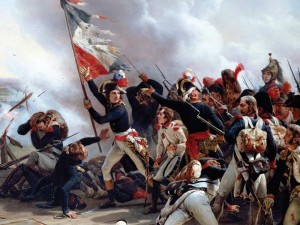
The French Revolution (1789-1794) which is echoed through three words, namely liberte, egalite, et fraternite (freedom, equality, and brotherhood) according to a figure named Alexis de Tocqueville is the most munomental revolution. [1] The condition of France before the revolution was still firmly under the power of the monarchy under the absolute power of king Louis XVI. But when Robespierre managed to move the masses to fight against L ‘Ancien Regiem (the old regime), then that was when fundamental changes occurred to France.
Many interesting things related to this revolution. Therefore, in the next discussion we will try to explain further matters related to the French revolution (1789-1794).
The State of France Towards the Revolution
L ‘Ancien Regiem or commonly referred to as the Old French Regime, is a time when France was under absolute rule by the Absolute Monarchy led by Louis XVI. This regime is also called the obsolete economic system [2]. Basically, this regime for the French people especially for farmers is the availability of land, planting wheat, as well as traditional methods used for farming.
In 1708 and 1741, France experienced a period of very crisis. The economic and social situation of France at that time was hit by a scarcity of wheat which later impacted on the high price of bread. The climax of this situation is the widespread hunger which then results in the death of too many people, especially those from the poor. This situation is caused both by natural factors and other factors, such as war accompanied by robbery and other criminal acts.
The social level of French society at this time consisted of at least three layers of society, namely the nobility, the bourgeoisie [3], and the poor who were usually only as farmers who cultivated lands in France in traditional ways. The situation of the French farmers during the old regime can be said to be very stressful. They must be bound by the feudal lords who control the lands they are working on. There is almost no land that is free from the “highest law” of the aristocratic landowners, so all land cultivated by farmers must be bound by feudal law. Whereas the bourgeoisie began to emerge when France had experienced economic progress. They had secretly entered into feudal society and had succeeded in buying land and becoming landlords. The situation of the farmers became even more worrying with the imposition of a large tax [4] that they had to pay to the landlord in both money and crops.
In the religious aspect, France is dominated by Catholicism which has been formalized as the State religion, based on a statute determined by Concordat in 1516. This has an impact on the legal recognition that all French people are Catholic. But even so, there are two religious minorities in France, namely Protestants and Jews. About six hundred thousand Protestant communities, mainly in the Midi area which later won recognition in 1787. While Jews are known as foreigners in the Alsace region and in the Southwestern part of France. [5]
In the political aspect, as mentioned earlier that France during the Old Regime was under the rule of a king with the Absolute Monarchy system. The king is a bureaucratic leader who is centered in the Palace of Versailles, and the Bastille prison is a symbol of this regime. Kings in France held a dual role, namely as the ruler of all landowners and also as a feudal lord, the greatest owner of the kingdom.
During the reign of king Louis XVI [6] France experienced a very critical period, both in economic and government aspects. From an economic standpoint, a decline in the price of wheat lasted quite a long time. In the social field there was a conflict between the nobility and the bourgeoisie. In the palace circles, people continue to maintain the integrity of his power. While the ideas of reform that developed specifically in the city of Paris continued to proclaim reform. While the king Louis XVI increasingly powerless against the state of the State that he was leading.
King Louis XVI had a wife named Marie Antoinette who was very unpopular with the people. The queen was dubbed the I ‘Austrichienne (the woman from Austria) and also Madame Deficit (the lady who caused the deficit). She is indeed an Austrian woman and at the same time a secret agent for her mother and sister, queen Marie Therese and Joseph II. The queen felt very dissatisfied with her marriage to the king, so she was eager to plunge into the world of politics in the kingdom. The second nickname, “lady causes deficit”, is a nickname given by her people because of the queen’s luxurious and extravagant lifestyle, and influences the lifestyle of all the relatives of the royal court of France. In addition, the queen is also recorded in history as an elite class play-girl, who betrayed her husband with his best friends. [7] The hatred of the people towards the queen was even greater when the 1786 event, the “Necklace Event” [8].
What has been described previously is a condition which will then bring France to the gates of the revolution. In addition, there are special reasons that will eventually spark this French revolution, namely the influence of the US independence war. France interferes in American war affairs with corrupt finances. Necker (Jacques) [9] who at that time controlled the field, turned to shortcuts by applying a loan system. He manipulated the State budget report, which then led to the prosecution of his dismissal by queen Marie Antoinette.
The French Revolution occurred
In France, starting in 1789 the revolution will go further. The integration of resistance between the nobility, the bourgeoisie and the peasants around early August will result in the collapse of the old regime. The time limits used are from 1789-1794. Based on the data found by the author, it was found that the year 1789 was an attack carried out by the revolutionary group against the Bastille prison, while the year 1794 was the collapse of the French republican regime led by Robespierre [10].
In early July, a feeling of total panic raged in the rural areas of Normandie. In cities, especially Paris, the atmosphere is getting tense. The nobles and their accomplices began to be threatened. On July 14 the people of Paris rose and attacked the armory, seizing the Bastille [11], which was also used as a State prison and was a symbol of the king’s arbitrariness. [12]
On Tuesday, July 14, 1789, about nine hundred Parisians gathered around the Bastille prison. Their aim was to seize ammunition, then demand that the cannon be handed over to the Paris militia. The Bastille Prison was currently being guarded by 82 invalides. The warriors were also strengthened by 32 troops from the Swiss Salis-Sanade regiment. The lack of escort clearly made panic governor Bernard-Rene De Launey who also doubles as the head of the prison. [13]
At ten in the morning, two people were sent to meet De Launey. But the meeting did not produce results, until the masses began to fierce, and finally heard a loud cry, “assaulted Bastille!”. The tense situation then moved de Launey to blow up 250 barrels of gunpowder. Bequard – a soldier – persuaded de Launey not to do it because there would be many citizens who were roasted alive. At 3:30 pm, civilian troops and people’s ranks reinforced the nine hundred Parisians. Bestille was finally attacked. The fighting killed 83 civilian soldiers, 15 died of serious injuries, and 1 invalides died. The fate of Launey himself must end tragically. His neck was cut using a folding knife by Desnot, and his head was displayed in front of the de Ville hotel.
July 14 is celebrated as France’s national day. The Paris rebels formed a rebel city council, a national guard force, and created a blue, red (Parisian) color, and white (king color) color, which was then used as the color of the French flag. While the national anthem is Marseillaise. The revolution continued to spread throughout France in a flash. In all provinces armed people seized power from city councils. The peasants invaded Puri seigneur and demanded that the archives of the feodeux droits be burned. The rebels frightened one another, causing a great panic in three quarters of France for fifteen days. The end of the peasant revolt was the abolition of the feudal system. [14]
The end of the life of king Louis XVI and his wife is very tragic. In 1792, the Legislative Council made two important decisions, namely abolishing the old form of government, namely the monarchy to become the republic of France, and sentenced guillotine to Louis XVI and his wife, Maria Antoinette, and other captured royal nobles. The execution of the king Louis XVI was carried out in January 1793 at 10.20. He was slaughtered with a knife made by Dr. Joseph-Ignace Guilotine. His head separated from his body was displayed to the public. While the execution of two thousand people was carried out in September 1792.
After becoming a republic, France was led by Robespierre (1793-1794). But the riots continued. The bourgeoisie finally succeeded in overthrowing Robespierre’s power in 1975. Then, five directors consisting of Barra, Moulin, Gobier, Roger Ducas, and Sieyes formed a ruling directorate government until 1799, and were later dissolved by Napoleon [15] who at that time served as consul. In 1804, Napoleon appointed himself emperor of France which was inaugurated by Pope Pius VII. The contribution of a Napoleon Bonaparte to France was in the military sphere, although his ambition to unite all of mainland Europe ended in failure.
The State of France Post-Revolution
The French Revolution does have implications in all aspects of life, but the most prominent is the scientific revolution and the birth of new ideas that are very significant, such as liberalism, democracy, and nationalism as the development of the slogan echoed during the revolution, namely Liberte (freedom ), egalitarian (similarity), and fraternette (brotherhood).
In addition, the emergence of the development of natural sciences with Newton’s fiisca model that influenced the philosophers’ thinking and the appearance of the name Auguste Comte who wrote several books about post-revolutionary society. Another most significant impact was the collapse of the old regime, namely the absolute monarchy system under the leadership of King Louis XVI. The old regime was then replaced by a new order of power, in the form of a republic. Then become France as a republic.
Not only in the field of politics, the French revolution led to changes in the economic field in France. A very significant thing is the abolition of the feudal system. Excessive tax collection and previously very burdensome to the peasants, were finally abolished by the nobility and priests. Tax payments are also submitted to the State for the progress of the nation. In addition, the people also have the right to own land. [17] In the social field led France to the formation of the working class, peasants and capitalists.
Conclusion
The French Revolution that occurred in 1789-1794 was a major revolution which would later give birth to many fundamental changes in France. Many factors lie behind the outbreak of this revolution, including the pressures experienced by farmers, both pressures originating from nature and pressures caused by taxes imposed on them. In addition, the inadequacy of the king Louis XVI who was then the holder of absolute monarchical power in France was also one of the factors that led France to the revolution.
After experiencing a long and serious dynamics, the Bastille prison was finally taken over by the revolutionaries on July 14, 1789. After the old regime was broken down, many changes occurred in France. Among them is a change in the system of government which was originally an absolute democracy and then converted into a French republic. The abolition of the feudal system was also one of the effects of the outbreak of the revolution in France, as well as several other effects that were explained in the previous chapter.









 Superheroine Spandexer