Che Guevara Against Imperialism in Latin America

Argentine-born revolutionary Ernesto Che Guevara is famous throughout the world for his commitment to defending international social justice during the mid-20th century. Although he was hated and loved for his guerrilla warfare tactics he advocated in Cuba, Congo and Bolivia, his writings continued to offer insights on world history from an internationalist perspective.

People identify with a sense of social justice, idealism, and rebellion. An Argentine who fights for independence in Cuba, Congo and Bolivia. Guevara is a new human representative without a state committed to international socialism. His published criticisms of capitalism and imperialism reflect an understanding that these two problems and solutions of the 20th century are global.

Che Guevara’s Struggle Background
Ernesto Che Guebara was born in Rosario, Argentina in 1928. He studied at home until the age of 9, due to severe asthma. Throughout his life, he loved to read and in adulthood, he had knowledge of subjects that included literature, Latin American poetry, and Spanish, French existentialist philosophy, Marxism, psychology, and archeology.

In December 1952, Guevara rested for eight months from medical school to go to South America with a friend. On his journey he witnessed the general condition of indigenous peoples throughout South America and was particularly moved by the conditions of copper miners in Chile. He linked the problems of the Latin American economy with large penetration by foreign companies.

After graduating in 1953, Guevara continued his journey to the capital of Guatemala, where President Jacobo Arbenz opposed the claims of the United States of America in the fertile land of Guatemala. In this place Guevara met Hilda Gadea, a Perus activist who introduced her to the idea of ​​Mao Zedong. Together they witnessed a coup sponsored by C.I.A to overthrow Arbenz in 1954, while simultaneously dropping Guatemala into a period of political violence for 4 decades.

The Guatemalan coup further convinced Guevara that the main problem of the American Exercise in the 1950s was “Yankee Imperialism”. He understood this imperialism as a combined political, military and economic power created by US policy makers and companies and their local collaborators on the economies of the Latin American region. This also convinced him that an armed revolution would be needed to overcome the problem in much of Latin America.

Struggle in Cuba

Guevara and Gadea split after the fall of the Guatemalan government, both of whom sought refuge in their respective national embassies. However, by chance they met again in Mexico City and decided to get married.

It was in Mexico City that Guevara met with Fidel Castro, who had just failed to overthrow the dictatorship of Fulgencio Batista in 1953. After serving a prison sentence of less than two years, Castro and other Cuban exiles met again in Mexico City. The meeting developed a relationship between Vsdtro and Guevara.

These exiles shared with Guevara their concern for the strength of the United States that enveloped Latin America and planned to take the fight. Finally, on November 25, 1956, eighty-one Cubans and Guevara launched their invasion of Cuba.

Initially, Guevara was trusted as a doctor in the group, but he also proved himself to be an excellent guerrilla warrior, and earned the highest rank among the rebels.

In January 1958 he and his comrades made it to Havana, which marked the victory of the revolutionary forces in Cuba.

During the war, Guevara founded a school to teach guerrilla fighters to read, print pamphlets, and use radio stations. In Cuba, he met Aleida March who became his second wife. He then published the first official history of the Cuban Revolution and popularized the foco guerrilla war, which argued that a small group of committed individuals could create conditions for revolution on a broader scale.

After the war, Guevara served as industry minister and head of the national bank. However, in many publications, his speech was known throughout the world as the face of the Cuban Revolution which made him a loved and hated celebrity.

As a new human prototype, Guevara is motivated by moral incentives and hopes to eliminate money. He also encouraged international cooperation to build a socialist society. Guevara represented humanist Marxism, offering a new possibility for communists who opposed Stalinism.

End of Guevara’s Struggle
Although known as a diligent bureaucrat, that position does not suit him. In 1965, Guevara disappeared from Cuba. He calmly organized a guerrilla war for independence in Congo.

Despite leaving his Kuban citizenship in a farewell letter with Castro, Guevara returned to Cuba in March 1966.

Next he launched the last failed guerrilla campaign, hoping to inspire a peasant revolution in Bolivia. His guerrillas fought in their last battle on October 8, 1967 against the Bolivian army who cooperated with C.I.A. During the battle Guevara was captured and executed the following day.

The controversy includes the revolutionary method handed down by Guevara, but his analysis of imperialism as a way to understand the past and the present offers insight into world history from an internationalist perspective, and not a commitment to the state / nation. His ideas and sacrifice continue to inspire the social justice movement. While Guevara’s place in world history as a global revolutionary will always be remembered. While his contribution as a social and political thinker continues.

Fighting Stigma

Humans indeed have long entered modern mada. Various advances also occur in every line of life. However, not all humans can enjoy this progress. Many minority groups who until now still have difficulty enjoying independence as a whole human being. One of the minority groups is the disabled group. As the largest minority, the diffable are still difficult in spite of all forms of discrimination and stigma that haunt them throughout life. Indeed, since the 19th century many policies emerged for them, but not all of these regulations can be applied. This condition is trying to change by Helen Keller.

As a disabled person, he really understands how difficulties are faced in living life. But he did not give up, he continued to study and study until he finally became an activist engaged in defending the right of the disabled.

Vision and hearing loss
Helen Adams Keller was born on June 27, 1880, in Tuscumbia, Alabam. He is the first child of two siblings, the son of Arhur H. Keller and Katherine Adams Keller. His father was editor of a local newspaper weekly and had served as captain of the Confederate Army during the Civil War in America (Keller, 1903: 4). His family is not very rich and earns income from their cotton plantations.

Keller was born with his sense of sight and hearing. He started talking when he was only 6 months old and started walking at the age of 1 year.

In February 1882, when Keller was 19 months old, he was stricken with a disease called “brain fever”. The pain was so severe that doctors thought Keller would not survive (Keller, 1903: 7).

After the fever began to fade, Keller’s mother noticed that her daughter showed no reaction when the dinner bell rang or when a hand waved in front of her face. From then on, his family concluded that Keller had lost his sight and hearing.

Keller who lost two important senses, then developed a method of limited communication with his friend, Martha Washington, the young daughter of the family cook. Both of them have created a kind of sign language.

However, a change in attitude occurred to Keller, he became very wild and difficult to manage. He will kick and scream when angry, and giggle uncontrollably when happy. He tortured Martha and raged at her parents. Many family relatives felt he needed to be rehabilitated.

Meeting Helen Keller and Anne Sullivan
Despite being asked to send their children to a rehabilitation center, Keller’s parents prefer to find other solutions for their daughter. In 1886, Keller’s mother was inspired by Charles Dickens’ account of a successful education story for deaf and blind women, Laura Bridgman. Therefore, they invited young Keller to seek the advice of doctor J. Julian Chisholm, an eye specialist, and ENT in Baltimore .

The doctor then referred Kellers to Alexander Graham Bell, who was dealing with deaf children. Bell advised them to contact the Perkins Blind Institute (Nielsen, 2004: 1).

Michael Anagnos, the school director asked the 20-year-old school alumnus (Chamberlain, 1899: 289), Anne Mansfield Sullivan, who also had a vision problem to become a teacher for Keller.

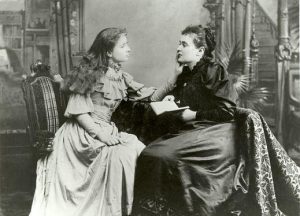
This meeting was the beginning of their close relationship for almost 50 years. During his time with Keller, Sullivan not only became a teacher but also became his best friend and friend.

Sullivan arrived at Keller’s house on March 5, 1887. That day was considered by Keller as the most important day of his life. Sullivan immediately began to teach him to communicate by spelling words using his hands, starting with “d-o-l-l” for a doll given to Keller (Keller, 1903: 22).

At first Keller was frustrated because he did not understand that each object has a word that uniquely identifies it. In fact, when Sullivan tried to teach Keller the word for “mug,” Keller became so frustrated that he broke the mug.

But he was soon able to imitate Sullivan’s hand movements. “I didn’t know that I spell the word or even the words exist,” Keller remembers. “I just made my fingers mimic like a monkey.”

In the following month Keller’s communication continued to develop. One that made his enthusiasm for learning even greater was when he discovered how to spell “water”. With the one-handed method of sensing the movements of his teacher, while one-hand flowing with cold water, he succeeded in finding ideas about water (Rankin, 1908: 86). After that, Sullivan also taught him to know various objects in the world.

Helen Keller’s Education
Within a few months Keller had learned to feel objects and associate them with words spelled with finger signals in the palm of his hand, to read sentences by feeling the words that appeared on the cardboard, and making his own sentences by arranging words in a frame.

During 1888-1890 Keller spent the winter at the Perkins Institute to study Braille. In March 1990, Keller’s desire to learn to speak emerged. He expressed his desire to Sullivan. His teacher then took him to meet Sarah Fuller at Horace Mann School for the Deaf. Under Fuller’s guidance, Keller began to learn to speak (Fuller, 1892: 24). In addition to learning to communicate, Keller also studies regular academic subjects.

Keller was not satisfied, because he was also determined to go to college. In 1896, he attended the Cambridge School for Young Ladies, a preparatory school for women. At this preparatory school, Keller was able to use using braille stationery, and read braille books about the history of Ynani, Rome, and the United States. In addition, he can use ordinary typewriters and Braille letters. He also studied French and Latin grammar. Nevertheless, there are still many people who still doubt whether he is able to attend lectures (Schraff, 2008: 28-29).

On the other hand, his story spread quickly, reaching the ears of famous and influential people. One of them was writer Mark Twain, who was very impressed with him. They became friends (Keller, 1903: 138).

Twain then introduced him to his friend Henry H. Rogers, a Standard Oil executive. Rogers was so impressed with Keller’s talent, enthusiasm, and determination that he agreed to pay for his studies at Radcliffe College (Harvard University women’s branch).

On that campus, he was still accompanied by Sullivan, who sat by his side to interpret lectures and literary texts. When he began college, Keller had mastered several methods of communication, including reading by touch, Braille, speaking, typing, and spelling with fingers. Therefore, he also took the time to write his first book Story of My Life, published in 1903.

Keller’s lectures were fairly smooth, because he successfully completed his studies in only 4 years and graduated with cum laude predictions (Hitz, 1906: 320). This graduation made him the first tunaganda to get a bachelor’s degree.

Become a Social Activist
After graduating, Keller began to learn more about the world and how he could help improve the lives of others. Keller became a member of the Socialist Party in 1909, most likely because of his friendship with John Macy, a lecturer at Harvard and husband Anne Sullivan. During his active membership in the party, he wrote several articles on socialism, women’s rights, disability rights, and the effects of war (Giffin, 1984: 1; Nielsen, 2004: 24).

His series of essays on socialism, entitled “Out of the Dark,” illustrates his views on socialism and world affairs. It was during this time that Keller first experienced public prejudice about his disability. Previously, the press always supported him, praising his courage and intelligence. However, after he expressed his socialist views, some media criticized and linked him with disabilities. The criticism shows that the American public still makes impairment as a reason to discriminate against others who are not in line with them.

However, this criticism did not dampen Keller’s spirit of activism. Because in 1915, together with famous city planner George Kessler, he took part in the founding of Helen Keller International. This organization has a mission to fight the causes and consequences of blindness and malnutrition.

The story spread outside Massachusetts and New England. By sharing his experiences, Keller became a disabled person who influenced his time. He even spoke before the Congress and advocated for the improvement of the welfare of the blind.

When the American Foundation for the Blind was founded in 1921, Keller was made a role model and symbol in the federation. Keller himself became a member of this federation in 1924 and participated in many campaigns to raise awareness, donations and support for the blind (Nielsen, 2004: 47). In addition to this federation, he also joined the Permanent Blind War Relief Fund organization (later called the American Braille Press).

In 1946, Keller was appointed as international relations advisor to the American Foundation of Overseas Blind. Between 1946 and 1957, he traveled to 35 countries on five continents.

Keller suffered a stroke in 1961 and spent the rest of his life in his home in Connecticut. He died in his sleep on June 1, 1968, only a few weeks before his 88th birthday (Schraff, 2008: 60).

During his extraordinary life, Keller became an example of how determination, hard work, and imagination can enable one to overcome obstacles. He overcame his difficult conditions with perseverance and developed into a progressive humanitarian activist who is respected by the world.

Korean War

The Korean War was the first major conflict that occurred during the Cold War. The conflict between North and South Korea took place between June 1950 and July 27, 1953. The war known as the forgotten war claimed millions of lives. All of Korea embraced a terrible destruction and took decades to recover.

Historical Background of the Korean War

Korea is an area that is not too broad, because it only occupies 85.246 square miles of land. The Korean region is more of an archipelago, with a coastline of 5,400 miles and is heavily influenced by the sea.

Before 1945, Korea was a unity. The kingdom of ancient Korea was united by the Tang Dynasty in 668 AD. This united Korea survived for 1300 years before it finally broke.

Korea was split into two parts after maneuvers carried out by the Allies towards the end of World War II. During the war, Korea was a territory controlled by Japan. However, after Japan’s defeat in World War II, Korea was divided into two parts in the 38th parallel. The Soviets occupied North Korea, while the United States occupied the south.

After Korea was separated, the two superpower countries had invested in each other in mainland Korea. With the intensification of the World War between the Soviets and the United States, the dividing lines of North and South Korea became a new iron curtain that separated Koreans from each other. Although separated by the two parts of the region, it became a show of strength of the Soviet Union and the United States. Thus, conflicts between the two are very likely to occur.

North Korea’s leader, Kim II Sung is very ambitious to unite Korea. Therefore, he asked for the support of the Soviet Union leader, Joseph Stalin in April 1950. Stalin finally agreed to support the North Korean invasion of South Korea. He only asked Kim to ensure that the victory could be achieved and the Soviets would not intervene directly.

After obtaining Stalin’s support, Kim then visited the leader of the Chinese Communist Party, Mao Zedong in Beijing. Mao agreed that only military power could unite Korea. He also doubted the United States would pay attention to the war in Korea.

While Kim confidently told Mao that his army would rule all of Korea within three weeks, long before American intervention might occur.

The start of the Korean War

The war began on Sunday morning, June 25, 1950, after the North Korean People’s Army (NKPA) crossed the thirty-eighth parallel, supported by Soviet-made T-34 tanks. The attack was unexpected both in time and intensity.

Meanwhile, the Republic of Korea (South) forces who were not yet well-trained or had the weapons to meet the challenge withdrew. NKPA moved quickly, took over the Korean capital in Seoul, and then crossed the Han River and went west to the Kum River, then south to Taejon and Taegu. North Korea, under the auspices of the Soviet Union, wishes to make all of Korea a communist regime.

US President, Harry S. Truman, ordered US ground and air forces to evacuate residents. He also ordered the US Seventh Fleet to go to the Taiwan Strait to prevent confrontations between the Communists and Chinese Nationalists.

Within two days, the United Nations adopted a resolution proposed by the United States, which called on the troops of the People’s Democratic Republic of Korea to withdraw.

Although called upon to withdraw, the North Korean People’s Army moved further south. Truman who was worried about the power of North Korea authorized General Douglas MacArthur to send ground troops. Despite the presence of American troops, North Korean troops continue to move south.

The 24th Infantry Division, led by General William Dean, was the first to react to hampering the North Korean army. The division was then assisted by the Fifth Air Force who was transferred to Korea, although in the end it still could not stop the NKPA’s power.

In late July 1950, the United Nations took a position along the Naktong Perimeter to consolidate its forces consisting of: the First American Cavalry Division, the Second Infantry Division, the 24th Infantry Division, the 25th Infantry Division, and the First Marine Brigade, and five South Korean infantry divisions.

Immediately after the call from the United Nations, member states began sending troops and supplies. Britain was the first country to respond, placing their ships in Japanese waters under the command of the United Nations. Most countries cannot send many troops, but 17 have succeeded in giving at least financial strength to the United Nations Command.

Battle at Inchon and Yalu
On September 15, 1950, after expanding troops and building supply lines, General MacArthur began planning a plan which he had considered from the start. The operation was called Operation Chromite, which is the amphibious troop landing at the west coast port of Inchon.

As a preparation, he formed the X Corps under the command of General Edward (Ned) Almond. The force consisted of the Seventh Infantry Division (Army) and the First Marine Division. X Corps moves around the southern tip of Korea. Amphibians then landed on the morning of September 15, 1950 and within a few days had taken control of Inchon and the Kimpo Airfield. In October, Seoul was regained and returned to President Syngman Rhee.

Meanwhile, the Eighth Army under the leadership of Lieutenant General Walton H. Walker had crossed the line and moved north quickly. They cut off supply and communication lines, so NKPA was forced to withdraw. Two successes of the operation left the UN forces in thirty-eight parallels in early October. In many ways the war may have ended at this time.

However, this favorable situation was considered the right time for the United States to occupy all of Korea and restore it as a unitary state. After obtaining permission from the Joint Chiefs of Staff and the United Nations, UN and Republic of Korea troops crossed the thirty-eight parallel and moved north.

Meanwhile the Eighth Army headed to the western side of the mountains, and the X Corps which had been moved by sea to the port of Wonsan, moved to the east side. Communication between the two forces is difficult. On Thanksgiving, the 17th Infantry Regiment in the US reached the Yalu River. It was at this point that the counterattack from South Korea and its supporters began.

The joining of China in the War
The People’s Republic of China has warned that if UN troops cross the thirty-eighth parallel, they will enter the war. But General MacArthur assured President Harry S. Truman that the threat would not occur.

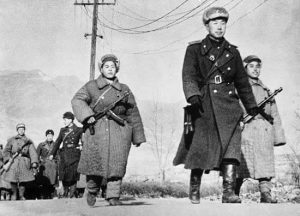
In mid-October 1950, there were clashes with the Chinese army. Then, on November 23, nearly 200,000 Chinese troops attacked. They passed the frozen Yalu River and gathered strength during November. The UN Command was hit hard by China, so Walker began to withdraw and evacuate troops by sea as much as possible.

To the east, X Corps also suffered defeat. Soldiers and Marines are pulled out under heavy pressure from the Chinese attack and the weather has fallen almost 40 degrees below zero Fahrenheit. When the army and marines retreated to the port of Hungnam, the navy began evacuating on Christmas Eve.

Nearly 100,000 UN and Republic of Korea troops, as well as most refugees, were evacuated. By December 25, the port had been destroyed, and most UN troops headed for Pusan ​​and other ports along the coast. Seoul was once again abandoned on January 3, 1951.

From then until the end of the war, China played a dominant role, not only in the procurement of military and civilian equipment and equipment, but also in the direction of strategy. Although the North Korean army continues to play an important role, both military authorities and civilian historians identify this Chinese attack as marking a new phase of conflict. In addition, China will also play a major role in negotiations which began in 1952.

The War on the Hills and the Long Debate Begins
General Walton Walker died in a jeep accident towards the end of December 1950. His successor, General Matthew B. Ridgway, arrived at Christmas and began the process of rebuilding the Eighth Army whose morale was destroyed after losing.

The effort was successful, Seoul was recaptured and on March 27, 1951. The Eighth Army kept moving until it reached the thirty-eighth parallel. In Operation Rugged, Ridgway’s forces established the Wyoming and Kansas Lines, which would become the main line of resistance for the entire war.

In early 1952, most of the territorial rights had been severed, and in early November 1952 the United Nations Command adopted a defensive policy and began inviting the communists to negotiate.

During this period military operations were not carried out in large numbers, but the war was focused on hills, outposts, and small bunkers. This is because the number of troops and supplies is decreasing on both sides. Soldiers and machines are limited by the scope of tasks, such as destroying a fortress, dismantling a bunker or disrupting supply lines.

The battle was confined to the hills, and the units involved were often no more than a company of troops. Success or failure at the conference table is reflected in success or failure on the ground. Peace talks continued, as the fighting in the hills was still fierce.

The United Nations and communist countries entered into negotiations with very different concepts and desires. In addition, problems arise around prisoners of war between the two parties. The negotiation process was very slow and frustrating, talks were stopped many times, and consequently reflected the political atmosphere rather than the military.

End of the Korean War: Weapons
Shortly after Joseph Stalin’s death on March 5, 1953, the communists returned to the negotiating table and agreed to exchange prisoners. Changes in the international environment were reflected in various peace proposals offered. However, the clash of weapons depends on the agreement on the exchange of prisoners of war …

Whatever affects the achievement of the final agreement is difficult to ascertain. Certainly included the death of Joseph Stalin and Soviet domestic problems. The truce was signed by General William K. Harrison and General Mark Clark for the United Nations, Marshal Peng The-huai for the Republic of China, and Marshall Kim Il Sung and General Nam Il for North Korea. The Republic of Korea did not sign the agreement.

Despite having reached the ranks of weapons, there are still large numbers of North Koreans and a much smaller number of South Koreans refusing to be repatriated. Thus creating new disputes in the future between the two Koreas.

The Korean War brought huge losses to both sides. At least 33,741 US troops were killed in military action, 2,827 were killed in war-related situations, and 103,284 injured. While the death toll for the Republic of South Korea alone reached 59,000 killed and 290,000 troops wounded, plus civilian casualties that were enough to bring the toll to almost three million people.

More casualties were on the side of North Korea and China, at least 500,000 troops were killed and one million injured.

For material losses, South Korea was the most disadvantaged. Some villages were lost to the war and Seoul, the nation’s capital, was mostly razed to the ground. Railroad lines, communications, entire state infrastructure, hydroelectric power plants, factories, civil buildings, even farms and rice fields were destroyed.
Russian Japanese War

Japan’s Russian War is a military conflict between Japan and Russia in the Far East. This conflict caused Russia to abandon its expansionary policy in the region and Japan became the first Asian power in modern times to defeat European power.

Background of the Japanese Russian War

At the beginning of the 20th century, Russia had become a world power that counts with large areas in Eastern Europe and Central Asia. On the other hand, Japan is seen as a rising Asian power thanks to the Meiji Restoration.

In 1904, the Russian Empire, ruled by the autocratic Tsar Nicholas II, was seen as one of the largest territorial forces in the world.

In that year the Siberian shipping center from Vladivostok was forced to close for months due to winter. Therefore, the empire needed a harbor of warm water in the Pacific Ocean, both for trade purposes and a base for its growing navy.

To overcome this problem, Tsar Nicholas turned his attention to the Korean peninsula and China’s Liaodong. The Russian Empire had rented a port on the Liaodong Peninsula from China known as Port Arthur, but they wanted to have a strong base of operations under their control.

Meanwhile, Japan has paid special attention to Russia’s influence in the East Asian region since the First Sino-Japanese War of 1895. During the war, Russia provided military support to the Qing Empire in China during the conflict, which resulted in two Asian powers clashing with each other other.

With the history of Russian military aggression, at first Japan wanted to find an agreement by offering control of Manchuria, China. In return Japan will continue to maintain its influence over Korea.

However, Russia rejected Japan’s offer and demanded that North Korea from the 39th parallel be used as a neutral zone.

After negotiations failed, Japan chose the path of war by carrying out a surprise attack on the Russian navy at Port Arthur on February 8, 1904.

The Japanese Imperial Navy attack on the Russian Far East Fleet at Port Arthur was designed to intimidate Russian troops.

Under the leadership of Admiral Togo Heihachiro, the Imperial Japanese Navy sent torpedo ships to attack Russian navy ships. The attack damaged three of Russia’s largest ships: Tsesarevich, Retvizan and Pallada.

The next battle from Port Arthur began the next day.

Although the remnants of Russia’s Far East Fleet were largely protected inside the port at Port Arthur, previous attacks had succeeded in preventing Russia from fighting in the open sea. Japan also tried to blockade the port but failed.

Russia did not remain silent, they tried to counter the attack using mines. The counterattack managed to damage two Japanese warships. Nevertheless Japan still showed dominance in Port Arthur and continued to bombard the port with heavy weapons.

The Battle of Liaoyang
After attempts to attack the Russian fort on the ground failed and instead resulted in significant casualties for Japan, the persistence of the Asian forces finally paid off.

At the end of August, troops from northern Russia sent to assist the fleet at Port Arthur were beaten back by the Japanese at the Battle of Liaoyang. The Japanese attack was carried out from a new position obtained on the mainland around the port.

By the end of 1904, the Japanese navy had sunk every ship in the Russian Pacific fleet and had taken control of its garrison on a hill overlooking the harbor.

In early January 1905, Russian Major General Anatoly Stessel, commander of the Port Arthur garrison, decided to surrender because he thought the port was no longer worth defending. The decision surprised the leaders of both parties.

The decision to surrender Stessel, made Japan achieve a significant victory in the war. Meanwhile, Stessel was convicted of treason and sentenced to death for his decision, even though he was finally forgiven.

The Russian Navy also suffered heavy losses during the Battle of the Yellow Sea, forcing imperial leaders to mobilize their Baltic Fleet to the region as reinforcements.

War in Manchuria and Korea
At a time when Russia was disrupted and demoralized, Japanese ground forces began to control the Korean peninsula after landing at Incheon in South Korea now. Within two months, they had taken over Seoul and the entire peninsula.

In late April 1904, Japanese ground forces began planning an attack on Russian-controlled Manchuria in northeast China. During the first ground battle on the Yalu River, Japan launched a successful offensive against Russian Eastern Detachment and forced them to retreat back to Port Arthur in May 1904.

After going through intermittent battles during the Manchuria winter, the next important land battle in the conflict began on February 20, 1905, when Japanese troops invaded Russia in Mukden. The days of hard fighting ensued.

The great battle involved 330,000 Russian troops against 270,000 Japanese troops. This is one of the biggest land battles in history.

At the Battle of Mukden, the Japanese succeeded in pushing Russia and eventually forced them into full retreat. On March 10, after three weeks of fighting, Russia lost a significant number of troops and was pushed back north of Mukden. The loss in this battle was huge, around 89,000 Russians and 71,000 Japanese troops were killed.

Decisive Battle in the Tsushima Strait
Although Japan had achieved important victories during the Battle of Mukden, on the other hand they also suffered significant casualties.

Russian Baltic Fleet reinforcements finally arrived in May 1905, after sailing nearly 20,000 nautical miles – an extraordinary task, especially in the early 1900s – they still faced the daunting challenge of having to navigate the Sea of ​​Japan to get to Vladivostok, with Port Arthur no longer open to them.

To avoid Japanese surveillance, they chose to sail at night. However, Russian reinforcements can still be found by Japan, after a hospital ship turned on their lights in the dark.

Once again under the command of Admiral Togo Heihachiro, the Japanese navy tried to block Russian roads to Vladivostok and resulted in the outbreak of fighting in the Tsushima Strait on May 27, 1905.

On the following day, Russia lost eight battleships and more than 5,000 people. Only three ships finally reached their destination in Vladivostok.

This decisive victory forced Russia to negotiate a peace agreement.

Although Japan had won the war convincingly, the victory was costly, so the state treasury was almost empty. As a result, Japan lacked the negotiating power that could be expected.

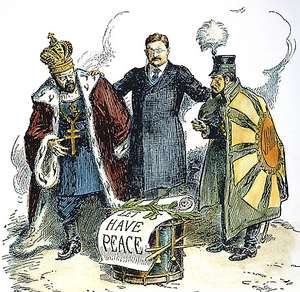
Under the terms of the agreement signed by both parties on September 5, 1905, Russia handed over Port Arthur to Japan, while defending the northern part of Sakhalin Island, which is located off the Pacific coast. Russia also agreed to leave Manchuria and recognize Japanese control over the Korean peninsula.

On the financial side Tsar Nicholas refused to pay compensation to Japan. The Tsar’s rejection was supported by Roosevelt. As a result, Japan accused the Americans of deceiving them and anti-American demonstrations in Tokyo appeared.

A series of embarrassing defeats of Russia in the Russo-Japanese War made the Russian Empire lose dignity and increase the Russian people’s hatred of the Tsar’s government. This hatred would later ignite political fire which eventually resulted in the overthrow of the government in the Bolshevik Revolution of 1917.

Although tensions in the region are far from over, the Russo-Japanese War has shifted the balance of global power, marking the first time in modern history that Asians have defeated Europeans in military battles. This war will also mark the start of a war involving world powers in the Pacific region.

Cursed Crusaders Fear Saladin

The story of Saladin Al-Ayyub or Saladin is often tinged with flattery. But there is another side to the cruelty of the commander in the Second Volume Crusade which made him very feared.

“Joseph, pack your things! We will leave! “

It was December 1168. More than twenty years before the Second Crusade broke out which would be an important event for the Islamic Kingdom to take Jerusalem. The governed figure is the nephew of a fat bodied one-eyed swordsman. The old commander is named Shirkuh.

This young man who is being governed is very different from his uncle. Thin, frail and 31 years old. Good looking, fair skinned, and has a melancholy facial line. His name is Yusuf bin Najmuddin. From the Kurds. On that day he was assigned by Sultan Nuruddin to take Shirkuh to bring the Islamic Kingdom troops from Damascus to Egypt to free Egypt from attacks by Christians. At that time Joseph was so scared.

“Like a man who is escorted to his death,” Yusuf suggested as told by Karen Armstrong in Holy War: The Crusades and Their Impacts on Today’s World (2001: 372-410).

After entering Egypt a few months later, the uncle suddenly died. Egypt has been mastered again. The problem then arises, who should replace the uncle?

Many amirs (leaders) are more worthy than Joseph, but some officials want someone who is loyal with a more friendly personality. Yusuf was the youngest and seemed inexperienced and the weakest among the emirs in the Shirkuh army, he was chosen to lead Egypt.

But who would have thought, a figure who was thought to be weak and too soft actually turned into a strong and effective figure in his jihad campaign to take Jerusalem. “When God gave me the land of Egypt, I was sure that He also intended to give me the land of Palestine,” Yusuf said in his inauguration as Vizier (a kind of governor) in Egypt.

And in the end, people will get to know their nickname: Saladin, which means “religious justice”. Or the crusaders knew him by the nickname “Saladin”. The most respected warlord – and at the same time feared – crusaders.

Saladin did not get the throne for granted. He first had to argue with Sultan Nuruddin who gave him orders along with his uncle when he was young and so innocent a few years before. Luckily, destiny was like appointing Saladin to lead Muslim troops in his jihad campaign. In the midst of Sultan Nuruddin preparing to fight Saladin’s “rebellion” in Egypt, on May 15, 1174 the Sultan died. Make the chair “caliph” empty just like that.

Saladin’s reputation as a highly religious figure made it easy for fanatics to put their support in him. The scattered and scattered Islamic provinces are united beneath it.

In the end, after 1181, for the first time – and the only one – in Islamic history, a Muslim empire that was so large and united in one banner. And at the same time, the name Yusuf sank engulfed in the greatness of his own nickname: Saladin Al-Ayyubi.

Saladin’s cruelty

In one of the most devastating battles in the second volume of the Crusade, there is a story that continues to be a picture of the crusaders how terrible Saladin’s army in the land of Palestine. The battle that took place on Mount Hattin, the Europeans called it “Battle of Hattin”.

The battle is also told – at least – by Ridley Scott in the film Kingdom of Heaven (2005). A battle that was even more fierce than the attempt to seize the City of Jerusalem itself a few months later.

The Crusaders were led by Guy de Lusignan at the time. A fanatic who became King of Jerusalem after the death of Sibylla’s son, King Baldwin V who succeeded his uncle, King “Lepra” Baldwin IV who was known to be very wise. Guy is very ambitious to finish off the “infidel forces” and is convinced that his invasion of Tiberias (the place where Saladin’s troops resided) was God’s destiny.

The battle of Hattin also had a chance to change perceptions about Saladin who was known to be compassionate to his enemies. Imaduddin al-Ishfakhani, Saladin’s secretary revealed his testimony, “That day I witnessed how Saladin killed the unbelievers to give breath to Islam and destroy polytheism to build monotheism.”

It was Reynauld of Chattilon, Guy the King of Jerusalem’s right hand, that made Saladin turn into a cruel figure. Four years earlier, Reynauld had killed Saladin’s younger sister when a ceasefire was still established between the crusaders and Muslim troops. Raping and slaughtering all Muslim caravans passing through Palestinian land. Execute and plunder Muslim territories.

When a Muslim warns of a truce still in effect, Reynauld instead rebukes, “Let your Muhammad come and help you!”

As if it was not enough to provoke Saladin, Reynauld also had a plan to attack the Muslim holy city: Mecca. This outrageous plan actually provides a multiplied force on the part of Muslim forces. All the tribes then united under Saladin’s banner and eliminated their respective disputes. Saladin also swore, “I will kill him with my own hands.” Then there was the biggest battle in the history of the Second Volume Crusade which was so cruel and decisive.

The defeat of the fanatics

Although the jihad campaign is a way of bringing all Muslim forces together, on the opposite side the same campaign is carried out in a far more banal way. Deadly common sense and seem to believe that God will help the Crusaders with miracles.

One of the signs came when Guy agreed to Reynauld’s proposal to go directly to Saladin’s troops in Tiberias. These blind fanatics ignore military reasoning. Hunt down Shaluhddin’s forces in the open instead of waiting behind the walls of the Jerusalem City castle.

With his 20 thousand troops, Guy and Raunauld crossed the Galilee valleys in the hot summer. Overburdened with their heavy armor. Saladin – although someone who is very religious – is a military commander with exceptional strategic intelligence. He knows that access to water is a decisive way for the battle this time.

Saladin dammed up water supplies and drained many springs. Instruct small group archers to target enemy soldiers who are separated from the group. The crusaders were half crazy because of thirst. Eventually they arrived at the Sea of ​​Galilee in a state of exhaustion and realized that the only source of water was the place where Saladin’s army camp was located.

Even without this tactic, Saladin actually could still win the battle – more than 10,000 Muslim troops, but Saladin knew, behind Guy and Reynauld, there was the City of Jerusalem that must be captured. In Saladin’s plan, it would be futile if the victory at Bukit Hattin did not continue to the next victory.

Under conditions of extreme fatigue and dehydration, the crusaders rested on Mount Hattin. The cheers of Saladin’s army were heard from afar. Shows how ready Saladin’s troops welcomed the victory that coincided on the 26/27 Ramadan. The Muslim holy day which Saladin finally commemorated as the night of the “nuzulul Quran” – the first day that the verses of the Koran were revealed to the world.

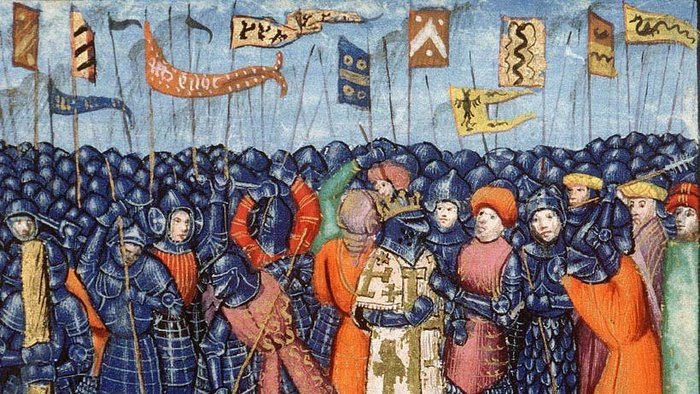
Finally at dawn on July 4, 1187 Saladin’s army set out to invade Hattin Hill where the crusaders were camping. Beating so hard and leaving only a few of them. Some of the barons and knights did escape the siege of Saladin’s army. Some of them were Balian de Ibelin, a figure who would lead the militia and the army of the people of Jerusalem to defend the city from Saladin’s army a few months later.

After the battle, Saladin brought the two most valuable prisoners into his tent. King Guy and Reynauld. Two men who were very tired and thirsty at the same time. Saladin gave Guy a refreshing ice water. Guy drank it, then gave it to Reynauld.

It is an Arabic tradition that a host cannot kill a man he feeds and drinks. When Reynauld drank so lightly without the host’s orders, Saladin asked, “Who allowed you to drink?”

Reynauld just didn’t budge. Saladin continued his sentence, “Therefore I am not required to show mercy to you.” As soon as the sentence was over, Saladin immediately pulled the sword out of his belt and beheaded Reynauld in the presence of a frightened and confident Guy that his turn would come.

Seeing Guy who was afraid Saladin then said, “The king did not kill the king. Why don’t you approach a great king to learn from his example? “

The great king in question is King Baldwin IV, the king who suffered from leprosy until he finally died. Leaving the Christian Kingdom of Jerusalem in the grip of King Guy the blind fanatic and making the Islamic Kingdom finally able to master it.

The Cruelty of Crazy French Colonialism

Not only Britain, Spain or the Netherlands are famous for their colonialism. France, too. In fact, this not-so-big country almost controlled around 7 percent of the world. A crazy achievement, although to get it France must do a lot of heinous actions.

Yes, just like the Dutch or other invaders, France is also known for its cruelty to the countries that were successfully colonized. Even when compared to the Netherlands, France is even more violent. Maybe it’s not something to be thankful for, but the suffering of the people of Indonesia will be even crazier like France had succeeded in making our country as their colony.

There are many countries that France has succeeded in subjugating, and just like the usual invaders, this newly emerging country has done many inhuman things. Following the review.

1. Algeria
Little difference with Indonesia which was colonized by the Netherlands, Algeria, for almost 132 years, experienced hard times with French colonialism. Instead of doing many good things, the government of French colonialism actually made this country a hell of its own people. A lot of tyranny has been recorded. Including the severe massacres that had occurred in Guelma.

France was proven to have committed a major crime, and even President Francois Hollande admitted it himself. In a speech, the president said that Algeria was a victim of the cruel system of its country. Despite claiming to be, Hollande was reluctant to apologize for what his people had done in the past.

2. Mali
Mali is also a French colony known as no less miserable. In 1892, France succeeded in taking power over Mali and making this country a coolie. Yes, most of the people are forced to become manual laborers through agriculture. Peanuts and cotton are the main productions.

Their suffering was so great, even this act of coercion was almost like slavery. Fortunately, after World War II the situation in Mali changed a lot and finally they were able to become independent in 1960. However, the suffering apparently still wasn’t really over for the Mali population. In recent years, France is known to carry out a military invasion that has sacrificed the lives of many civilians there.

3. Haiti
The French motivation in controlling Haiti was initially influenced by the El Dorado fable. In the past, it was believed that somewhere in Central America there was a city full of gold called El Dorado. This also made France tempted, until in the end to expand but did not produce anything. Even so, they managed to colonize Haiti.

Because the French motivation from the beginning was a treasure, so when in Haiti they were doing exploits like crazy. Unfortunately, Haiti doesn’t have many things. So that slavery is carried. Haitian slavery is like an economic commodity. During the period of French colonialism, slaves were traded like merchandise. Until finally decades after this event, Haiti rose and could get freedom. As a country or a human.

4. Chad
Chad was a prosperous country at first, even the most comfortable compared to the surrounding areas. However, this happy period ended when France colonized them in the early 19th century. The goal was the same, namely to be exploited and monopolized according to will.

There was so much suffering experienced by the Chadian people when it was colonized by France. Including horrific events in which religious leaders are treated cruelly until slaughtered. This era of French colonization then ended, but it still had a bad impact on Chad. The new government was successfully made but not in accordance with the conscience of the Chadian people. This even led to the coup plan to the civil war.

5. Vietnam
The history of the struggle of the Vietnamese people is not only about resistance against America, but also France. Yes, this one country was also quite a long time to colonize our neighbors. France treated Vietnam the same as other colonial areas. Massive exploitation of natural resources.

Vietnam’s struggle for independence is very heavy. They have to do many wars including the most severe is the Dien Phu War which takes years with hundreds of thousands of victims. In the end Vietnam won this upheaval and gained independence. Unfortunately, when France left, America intervened and there was the legendary Vietnam War.

Whether this is something to be grateful for or not, but you could say Indonesia is fortunate enough not to be colonized by France. As the story of the countries above are treated very improperly by France. Actually, going to France or the Netherlands, whose name is colonialism through colonialism is a bad thing. Seeing what the colonizing nations have done in the past, then they should apologize and compensate for all the things they have done.

British Colonize Aboriginal tribes

Australia, a continent which was originally inhabited by aboriginal tribes turned out to keep a painful story of colonialism to date. Australia, which is a continent of British prisoner exile, has indeed become a British commonwealth and has turned into a prosperous continent under the queen of England.

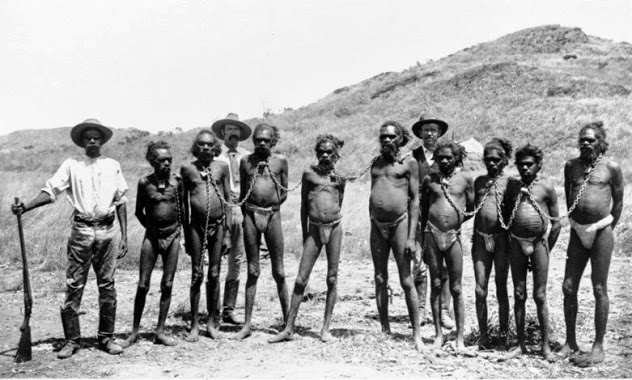
But the true Australian continent has been wrested from an indigenous tribe who lived 60 thousand years on this kangaroo continent. Aboriginal tribes, indigenous tribes of Australia are forcibly displaced and become slaves for years.

1. Early Arrival
During the ‘Carnaval of Crime’ crime in England increased and made prisons full. Britain also can no longer throw prisoners into the American continent because America has freed itself from Britain. Finally the navigation of Cook in 1770 returned to find Australia opening a gap to control the continent as Australia’s.

The arrival of the James Cook in 1770 was the beginning of the claim of British ownership of Australian land. The ship which was originally expedited to search for new land eventually became the first round of colonization of Aboriginal tribes. With the discovery of gold mines more and more British immigrants came and divided the land for settlements. This capture is often in contact with Aboriginal customary land.

2. Bad Treatment of the Invaders
At the beginning of their occupation, the British carried out a massacre in 1806. Hundreds of natives were shot and beaten to death. Recorded in the Independent newspaper report in 1997, there were many cases of rape that eventually transmitted the deadly disease to the Aboriginal people.

White people want to control mainland Australia and get rid of the indigenous tribes of Australia. They broke the bloody conflict because they treated the indigenous tribes badly. In the Australian colonial archives it was confirmed from 1824 to 1908 that at least 10 thousand Aboriginal tribes were killed. The file also mentions some of the victims killed because they became ‘toys of white people’.

3. A tribe that does not build
Guided by Darwin’s theory of evolution, the British saw the Aboriginal tribe as a non-constructing human species. In 1890 the vice president of the Royal Society in Tasmania, James Barnard wrote, “This process of annihilation is an evolutionary principle and it is the strong that continue to live.”

The results of this racist view made Aboriginal people massacred. Some decapitated heads were stuck at the door of the station, poisoned bread was given to Aboriginal families and even many of them were made experimental animals.

4. Abolition of Aboriginal Tribes
At the beginning of the 20th century, continued atrocities against these Aboriginal tribes. Systematic massacres were carried out by carrying out an ‘Assimilation’ policy. Aboriginal tribes are considered tribes left behind by civilization, because they choose to live in the wild or wear modest clothing.

This Assimilation Policy is enforced. In the period 1910 to 1970 more than 100 thousand Aboriginal children were forcibly taken away from their parents to be paired with white foster parents. They are required to speak English and discard all Aboriginal culture.

For Native Men who resist assimilation, the police have the right to beat him, even this assimilation occurred until 1970. Judge Ronald Wilson’s report also mentions the practice of discrimination and genocide even after Australia voluntarily signed the international treaty of the 1948 UN Charter.

5. The Struggle to Set Yourself Free
On 31 March 2014, the Aboriginal people showed their desire for independence from Britain. They want to end the colonial rule that has lasted more than 200 years, by sending a letter to Queen Elizabeth II and the Australian government.

A declaration of the establishment of the Murrawari state which became the home of the Aboriginal tribes had also been carried out. Previously the Aboriginal sovereignty movement in Australia was seen in 1972. An Aboriginal Camp Embassy Movement group supported indigenous land rights and expelled the British who never had legal authority over the Australian continent.

Discrimination against native kangaroo continents is indeed still happening today. This indigenous tribe is still isolated from the modern civilization of the continent of Australia with the placement of isolated regions. And various policies that exacerbate the extinction of this tribe.

The Tragedy of the Massacre of Thousands of Muslims in Srebrenica

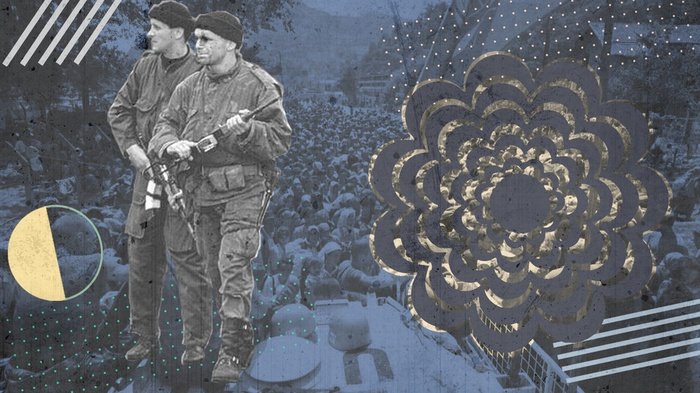
On July 11, 1995, exactly 23 years ago, began the most sadistic massacre in post-World War II Europe, according to former UN Secretary General Kofi Annan. He referred to the genocide of thousands of Bosnian Muslim citizens in Srebrenica City, Bosnia and Herzegovina.

The collapse of the Yugoslav Federal Socialist Republic became the main cause. The declaration of independence of the Bosnian Republic and Hezergovina was not recognized by the Serbian army and the Yugoslav People’s Army (JNA). Both want to secure territory, but apparently also followed by cleansing of non-Serbs in the area they are trying to control.

Srebenica is located at the eastern end of Bosnia and Hezergovina. The city became the next target after Serbian and JNA troops were satisfied ransacking Bratunac, an area also located on the border of the two countries. The majority of the population is Bosnian Muslims. Villages in the area were taken, houses burned, citizens beaten or killed. 1,156 Bratunac residents were killed, while others were forced to flee (and eventually concentrate) to Srebrenica.

Similar is happening in many countries, genocide does not take place overnight and overnight. The International Criminal Tribunal for the Former Yugoslavia (ICTY) noted campaigns as well as military attacks before ethnic cleansing had begun since 1992. Former Bosnian and Hezergovina military officials, Naser Oric, told ICTY that between April 1992-March 1993 Srebrenica residents were targeted by Srebrenica residents artillery attacks, fighter bombs, and snipers by Serbian troops.

“Potočari village is a daily target because it is a sensitive spot on the defensive line around Srebrenica. Other Bosnian Muslim settlements are also routinely attacked. All of this resulted in a large number of refugees and victims, “he said.

The Serbian army was exploited because it controlled the water supply and energy sources of the village community. Mass hunger occurs because assistance from humanitarian agencies is not permitted to enter. Even the elderly and children who are weak one by one fallen.

Mastermind of the cruel events in Srebrenica is Srpska (Serbian) Republican General nicknamed Bosnian Butcher, Ratko Mladic. He grew up to be a member of the Yugoslav Communist League, then a career in the Yugoslav People’s Army. His position skyrocketed from a high-ranking officer, Chief of Staff of the Army, until finally being appointed as general when entering the Bosnian War in 1992-1995.

Military uniform makes Mladic reveal his savage nature. On April 5, 1992, on the same day as the proclamation of independence for Bosnia and Herzegovina, Yugoslavian forces encircled the capital of Bosnia and Herzegovina, Sarajevo.

Mladic and his troops tried to occupy the city center and overthrow Bosnia’s official government through a coup. The siege of Sarajevo, referring to the final UN report, lasted 1,425 days (5 April 1992-29 February 1996) and became the longest siege in the history of world war.

Mladic and his army did eventually retreat. But the death toll reached 13,952 people, 5,434 of whom came from civilians.

Entering 1995, the situation in Srebrenica was increasingly dangerous. The UN then formed UNPROFOR troops which were filled by around 400 Dutch troops. Since April 1993, the UN has also made Srebrenica a safe area. This means that the city must not be used as a battle ground by all parties who are at war.

The Serbian army ignored him. Strike after attack was carried out as the troops kept surging inside. On June 4 1995 the superior number of Serb forces finally gained control of Srebrenica.

On July 6, Serbian forces began storming Dutch army posts. Five days later they managed to enter the refugee camps. Most of the children, women and parents who began to move to seek refuge in Potocari were also arrested.

The ICTY report explained that on July 11, 1995 the massacre began by separating men aged 12-77 years. The reason is to be interrogated, but this is only an excuse so that the target can be separated from women, parents, or other relatives.

The first murder took place in a warehouse near the village of Kravica, then continued to other corners of the village. The group of victims was told to line up near the hole made into a mass grave, then shot one by one in the back of the head. The soldiers then targeted all types of gender and age. Old, young, old people, children, even babies, all became targets of the Mladic forces’ cruelty. Not to mention the rape cases experienced by survivors and subsequently killed.

The Hague Court’s Notes (PDF) on this case, compiled in December 2007, reveal many sad stories from witnesses or survivors. One of them was Zumra Šehomerovic, who witnessed the horror of the Srebrenica Massacre, right before his eyes.

Sehomerovic saw a girl about nine years old in the clutches of JNA soldiers. One soldier told the girl’s younger brother to rape his brother. The younger brother clearly refused. The soldier was angry and then killed the boy.

“There is a mother with her baby who is only a few months old. A JNA soldier told him to calm the crying baby. The mother’s attempt failed, then the soldier grabbed the baby and cut his neck. He laughed. There are Dutch soldiers (UNPROFOR) who only watch and do nothing, “he said.

History highlights the failure of UNPROFOR in this case as a very fatal action. Allowing evil to occur in their eyes is only a small fragment.

When the massacre was taking place, Dutch troops surrendered 5,000 refugees in exchange for 14 of their troops held by Mladic. Until now the decision has sparked criticism and regret from both the UN and the Dutch government.
Independent reported that the Dutch troops claimed at the time that they also had the potential to become victims of Mladic atrocities. But exchanging 70 percent of Bosnians who were in despair with 14 opposing troops was also accused of multiplying more wrongly.

The initial list of persons missing or killed in Srebrenica compiled by the Bosnian Federal Missing Persons Commission stated that the total number of victims was 8,373. In July 2012, 6,838 victims of genocide were identified through DNA analysis. Capital is a body part found from a mass grave. In July 2013, 6,066 victims were buried in the Potocari Warning Center.

In commemoration of the 10th anniversary of the Srebrenica Massacre, Kofi Annan stated that the main mistake was indeed in the perpetrators of genocide, those who supported it, and those who took care of the burial of the victims. But he also stressed that the UN had made a serious mistake, “rooted in the philosophy of impartiality.” Srebrenica, he said, would be a tragedy that forever haunted the UN.

Mladic managed to escape after the end of the Bosnian War. For 14 years he was being chased by Serbian authorities. The initial price for information on the whereabouts of Mladic, which was clarified by the Serbian and United States Governments, was Rp90 billion. In 2010 the figure increased dramatically to Rp180 billion.

On May 26, 2011 plainclothes officers from the Serbian Interior Ministry special war crimes unit arrested Mladic in a village called Lazarevo. After being tried for 530 days, on November 22, 2017 he was found guilty as the mastermind of the Srebrenica genocide and sentenced to life imprisonment.

Genocide in Ethnic Conflict in Rwanda

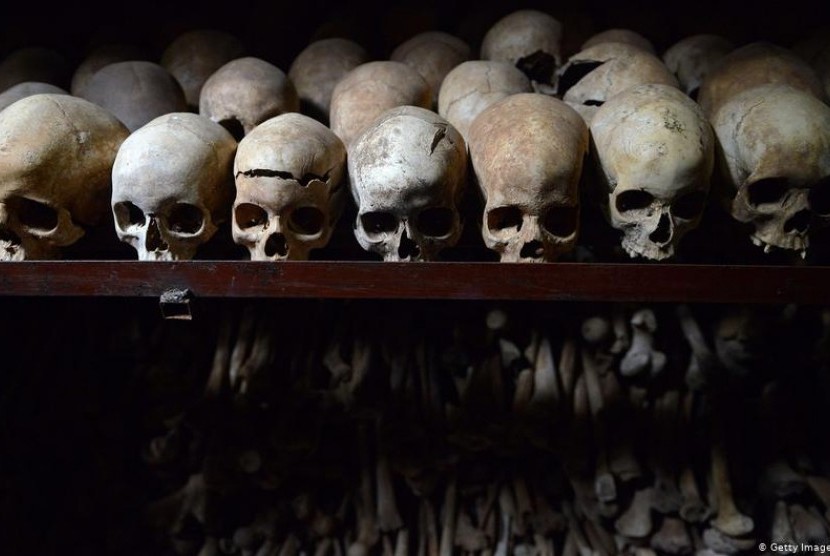
On April 7, 1994, the massacre of about 500 thousand to one million moderate Tutsis and Hutus began for 100 days. In Rwanda, the dark history of genocide is accepted in inter-ethnic conflict.

The Hutu and Tutsi ethnic groups in Rwanda have continued to flare up since independence from Belgium and the dissolution of the monarchic government led by the Tutsi king. On April 7, 1994, the turmoil culminated in genocide.

Hutu extremists who are the major ethnic ethnic groups in the country slaughtered Tutsis and moderate Hutus. Ethnic minority Tutsis are targets and targets of violence.

About 85 percent of Rwandans are ethnic Hutus and the rest are Tutsi and other smaller ethnic groups. Although a minority, Tutsi has long been known to occupy many sectors of leadership and government.

Reported by History, the direct roots of the 1994 genocide began in the early 1990s, when Rwandan President Juvenal Habyarimana, a Hutu, began using anti-Tutsi rhetoric to consolidate his power among the Hutus. In early October 1990 there was already a massacre of Tutsi.

Although the two ethnic groups have been very similar in sharing the same language and culture for centuries, the law requires registration based on ethnicity. The Rwandan government and army began to gather the Interahamwe (which means those who attacked together) and prepared to eliminate Tutsi by arming the Hutus with weapons and machetes. In January 1994, UN peacekeeping forces in Rwanda warned that a major massacre was imminent.

On the day before the massacre began, President Habyarimana was killed when his plane was shot down. That added fire to the Hutu extremists to Tutsi, because they thought the plane was shot by the Tutsi military organization or the Rwandan Patriotic Front (RPF).

The Hutu extremists in the military, led by Colonel Theoneste Bagosora, immediately acted to kill Tutsis and moderate Hutus within hours of the accident. The following day the Belgian peacekeepers were killed so the United Nations withdrew troops from Rwanda.

After that, radio stations in Rwanda broadcast hate propaganda to kill all Tutsis in the country. National army and police directed the massacre and threatened Hutu civilians. Thousands of Tutsis were tortured to death with machetes by their own neighbors and even some husbands killed their Tutsi wives because the militias threatened to kill if they refused.

Despite the terrible crimes, the international community including the United States is hesitant to take any action. They mistakenly regard genocide as chaos in the middle of a tribal war. President Bill Clinton later called America’s failure to do anything to stop genocide as the biggest regret of his administration.

That was left to the RPF, led by Paul Kagame to start a military campaign that finally succeeded in controlling Rwanda. In the summer, the RPF defeated the Hutu forces and drove them out of the country and into several neighboring countries. However, at that time, an estimated 75 percent of Tutsi living in Rwanda had been killed.

Genocide In Spanish

The April Fool’s celebration, which always ends with excitement and satisfaction, actually starts from a major tragedy that is very sad and heartbreaking. April Fool’s Day or “The April Fool’s Day” begins with an episode of the history of Muslim Spain in 1487 or coincides with 892 H. Before arriving at the tragedy, it is a good idea to look at Spanish history first while still under Islamic rule.

Since Islam was liberated in the 8th century AD by Commander Tariq bin Ziyad, Spain has gradually grown into a prosperous country. Islamic forces not only stopped in Spain, but continued to liberate in neighboring countries to France. Southern France can easily be freed. The city of Carcassone, Nimes, Bordeaux, Lyon, Poitou, Tours and so on fell. Although very strong, Islamic forces still tolerate the Goth and Navaro tribes in the western part of the mountains.

Islam has illuminated Spain. Because the attitude of the Islamic rulers was so kind and humble, many Spaniards who later sincerely and sincerely embraced Islam. Spanish Muslims are not only Muslim, but they truly practice Islamic life. They not only read the Qur’an, but also behave according to the Qur’an. They always say “no” to music, beer, promiscuity, and everything that is forbidden by Islam. This peaceful situation lasted for almost six centuries.

The History of “April Fool”

During those six centuries, the infidels who still exist around Spain tirelessly continued to try to rid Islam of Spain, but always failed. A number of spies were sent to study the weaknesses of Muslims in Spain. Finally, the spy found a way to conquer Islam in Spain, which must first weaken their faith first by attacking thought and culture.

So start secretly they send alcohol and cigarettes for free into the territory of Spain. Music is played to persuade young people to prefer singing and dancing rather than reading the Qur’an. They also sent a number of fake clerics whose work blew divisions within the bodies of Spanish Muslims. Over time this effort bore fruit.

Finally, Spain fell and could be controlled by the Crusaders. The attack by the Crusaders was really carried out cruelly without knowing humanity. Not only Islamic forces were slaughtered, but also civilians, women, small children, old people, all killed cruelly.

One by one the regions in Spain fell. Granada was the last to be conquered. The Muslim population in Spain (also called the Moors) was forced to take shelter in the house to save themselves. Christian soldiers continued to pursue them.

When the streets were quiet, leaving only thousands of corpses lying in a pool of blood, the Crusaders learned that many Granada Muslims were still hiding in homes. Loud the Crusaders shouted the announcement, that the Muslims of Granada could get out of the house safely and were allowed to sail out of Spain with their needs.

“We have prepared ships that will take you out of Spain at the port. We guarantee your safety if you want to get out of Spain, after this we will no longer give guarantees! ” Thus persuaded the Crusaders.

Muslims are still suspicious of this offer. Some of the Muslims are allowed to see the passenger ships that have been prepared at the port. After really seeing a ship that has been prepared, then they immediately prepare to leave Granada together to the ships. They were preparing to sail.

The next day, thousands of Granada’s Muslim residents came out of their homes, carrying all their necessities along the way to the harbor. Some Muslims who did not believe the Crusaders survived and continued to hide in their homes. After thousands of Spanish Muslims gathered at the port, the Crusaders quickly searched the houses that the inhabitants had left. Tongues of fire were seen lapping up the sky when the Crusaders burned the houses together with the Muslims who still survived in them.

While thousands of Muslims detained at the port could only be stunned, when the Crusaders also burned ships said to be carrying them out of Spain. The ships quickly sank. Thousands of Muslims cannot do anything because they are totally unarmed. They also consist mostly of women and children who are still small. Meanwhile, the Crusaders had surrounded them with drawn swords.

With a shout from the leader, thousands of Crusaders immediately slaughtered and finished off the Muslims of Spain without feeling of mercy. Crying and takbir blaring. With a ferocious Crusaders continued to kill civilians who were completely helpless.

All Spanish Muslims in the harbor were cruelly killed. Blood welled everywhere. The blue sea has turned blackish red. This tragedy coincides with April 1. This is then commemorated by the Christian world every April 1 as April Fool’s Day (The April Fool’s Day).

For Muslims, April Fool is certainly a very sad tragedy. The day thousands of brothers and sisters in the faith were “slaughtered” and massacred by the Crusaders in Granada, Spain. Therefore, it is very inappropriate if there are Muslims who join in celebrating this tradition. Because, by participating in celebrating April Fool’s Day, the Muslims actually rejoiced and laughed at the tragedy. Whoever is a Muslim who celebrates April Fools, is actually celebrating the anniversary of the massacre of thousands of his brothers in Granada, Spain, a few centuries ago.

“Surely the disbelievers are plotting evil deeds in the best way.” [Surah Ath Thaariq 86: 15]

“And I made a plan (too) with the truth.” [Surah Ath Thaariq 86: 16]

“Therefore give the unbelievers tough, that is, give them respite for a while.” [Surah Ath Thaariq 86: 17]

April Fools’ Day, a day where you can cheat others

April Fools are days when “they” may deceive others as a joke. Brother, every time before April 1, usually many of us will be so busy and carried away with Western culture. Many are preparing to celebrate by making big plans to deceive other people / closest friends / relatives.

O Muslims, be careful of this culture. Avoid ourselves from doing wrong, especially April Fool is not Islamic culture.

But do you know how many of us do not know the harsh reality of history that befell the Spanish Muslims behind the April Fools celebration? The tragedy of the slaughter of Spanish Muslims.

“The Jews and Christians will not be happy with you until you follow their religion. Say: ‘Verily Allah’s instructions are (true) instructions’. And truly if you follow their will after knowledge comes to you, then God will no longer be a protector and a helper to you. ” (QS Albaqarah 2: 120)

In a history it was stated, that the Jews of Medina and the Najran Nashara hoped that the Prophet sallallaahu ‘alayhi wa sallam prayed facing their qibla. When Allah Subhanahu wata’ala turned the Qibla to the Kaaba, they objected. They conspired and tried to make the Prophet sallallaahu ‘alayhi wa sallam approve the qibla in accordance with their religion. Then the above verse (Q. 2: 120) goes down which explains that the Jews and the people of Nashara will not be happy with the Prophet Muhammad, even if his wish is granted. (Narrated by Tsa’labi sourced from Ibn Abbas)

As said by Allah Subhanahu wata’ala, for all time, they will never lose their enemies of Islam to always destroy Islam and extinguish the light of Allah Subhanahu wata’ala. Various ways they will do, including the history of the slaughter of Spanish Muslims also April 1 developed into an April Fool’s celebration.

Sadly, ignorant Muslims also commemorate April Fool’s Day. Without realizing, they actually celebrated the anniversary of the mass murder of their own Muslim brothers.

O Muslims, be careful of this culture. Avoid ourselves from doing wrong. Remind our fellow Muslims. Remember that April 1 was the day of the massacre of the Spanish Muslims. And the important thing is, in the Koran & Hadith there are no orders which can deceive others as a joke.

May Allah always open the door to repentance for us. Amiiin ..

Design a site like this with WordPress.com
Get started